Male-Focused Psychotherapy for Men






Why Choose MMHI?
- collaborative, not judgmental
- structured, not vague
- focused on what’s happening in your life, not only on diagnoses
- understand how their internal reactions connect to conflict and disconnection
- develop language and tools for difficult conversations
- align their decisions with their values in relationships, work, and family
How It Works

Step 1: Book Your Intake Session
A paid 50–60 minute intake where we:
- explore what is bringing you in now
- clarify key patterns in your relationships, emotions, and behaviour
- discuss what you would like to work on over the next 8–12 weeks
- recommend a clinician who is a good fit for your needs
Step 2: Begin Weekly Sessions
You start regular online sessions with your therapist.
Sessions focus on:
- understanding your internal responses
- exploring how past experiences show up in the present
- practicing new ways of communicating and responding
- connecting thoughts, feelings, and actions more clearly
Step 3: Review & Adjust Over Time
We periodically review:
- what has felt helpful
- what feels stuck
- where you are noticing changes
Together, you and your therapist adjust goals and focus areas as needed.
No outcomes are guaranteed. Each person’s experience is shaped by many factors, including history, context, and engagement in the process.
Between-Session Support
Between-Session Support (Non-Urgent Accountability & Direction)
Most men don’t need someone on-call 24/7 they need direction, clarity, and the right nudge at the right time.
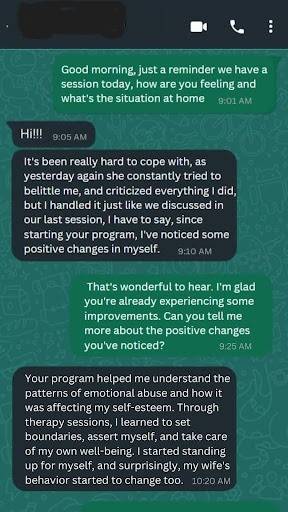
When clinically appropriate, MMHI offers short, focused check-ins between your regular sessions. These touchpoints help you:
- Stay aligned with your commitments
- Navigate ahigh-pressure moments with more stability
- Reinforce new emotional and relational habits
- Reflect before reacting, instead of repeating old patterns
These between-session check-ins are not emergency or crisis services.
If you’re in danger or experiencing a crisis, please contact your local emergency resources.
MMHI does not provide 24/7 urgent support.
Men often seek therapy at MMHI for one or more of the following:
1. Emotional Control & Overthinking
- Difficulty managing anger, withdrawal, or shutdown
- Frequent rumination or replaying conflicts
- Feeling like reactions are stronger than the situation
2. Relationship Conflict & Communication
- Recurring arguments that escalate quickly
- Feeling misunderstood or unseen in relationships
- Uncertainty about whether to stay, leave, or rebuild
3. Numbness, Low Mood, or Exhaustion
- Feeling flat, checked-out, or disconnected
- Struggling with motivation or enjoyment
- Carrying long-term stress that doesn’t switch off
4. High-Conflict or Confusing Relationship Dynamics
- Feeling destabilized in relationships with intense highs and lows
- Difficulty trusting your own perception
- Doubt about whether patterns are “normal” or harmful
5. Identity, Purpose, and Self-Respect
- Questioning who you are outside of performance roles
- Wanting to feel more grounded as a partner, father, or leader
- Wanting to live more in line with your own values
Who You’ll Work With
Our clinicians include:
- Registered Psychotherapists (RP, RP(Q))
- Clinicians with Master’s-level mental health training
They:
- practise in accordance with CRPO and other regulatory standards
- use evidence-informed therapeutic approaches
- participate in consultation and supervision as appropriate
Practice Standards
- PHIPA/HIPAA-aligned privacy practices
- Encrypted online platforms
- Clear consent, boundaries, and policies
- Advertising that is factual and verifiable (no testimonials or guarantees, per CRPO Standard 6.2).
PRICING & INSURANCE
Therapist Tiers
Fees are in CAD.
Insurance
Many clients receive partial reimbursement through extended health benefits where psychotherapy provided by a Registered Psychotherapist or social worker is covered.
MMHI does not bill insurance directly.
We provide detailed receipts you can submit to your insurer.
Meet the Therapists
Introduce a short grid with:
- Name + designation (e.g., MA, Registered Psychotherapist (Qualifying))
- 1–2 lines on focus areas (e.g., men’s relationships, anxiety, trauma, separation, etc.)
- A neutral, non-promotional description of style (e.g., “direct but compassionate; structured and collaborative”)